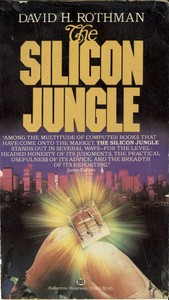
The Silicon Jungle by David H. Rothman
Always visible content "The Silicon Jungle" by David H. Rothman is an insightful guidebook on personal computing written in the mid-1980s. The book explores the evolving landscape of the computer revolution, emphasizing how technology impacts both individuals and businesses. It addresses critical issues such as computer security, productivity, and the competitive nature of the tech industry, offering practical advice for navigating this complex terrain. At the start of the book, Rothman sets the stage for Hidden checkbox to control the toggle Clickable label to show more The extra text that is initially hidden Clickable label to show less his exploration of the personal computer scene by describing the intense and often cutthroat competition that characterizes the industry. He illustrates this with examples of various businesses and individuals using technology—ranging from car thieves and journalists to lawyers—to gain an edge over their rivals. The opening portion introduces the concept of the "Silicon Jungle," emphasizing the need for strategic use of computers in everyday business operations and foreshadowing the more detailed analyses and case studies that will follow throughout the book. Rothman aims to empower his readers with knowledge and insights that will help them successfully navigate this technological landscape. (This is an automatically generated summary.)
Start Reading
Chapters (245)
- Chapter 1 Ch.1
- Chapter 7 and Backup VII, you’ll learn (1) the basics, (2) when charts Ch.2
- Chapter 12, “How I Found ‘God’ on MCI (and a Few Other Odds and Ends Ch.3
- 1. Bigger RAMs can work with more and larger numbers—a handy capability Ch.4
- 2. More RAM can accommodate programs more complicated for the computer. Ch.5
- 3. You may want the most sophisticated software to thwart computer Ch.6
- 1. You can quickly make safety copies of valuable disks—something that’s Ch.7
- 2. You can more easily work with long electronic documents. Ch.8
- 1. Absence of bugs. The software maker should have gotten all the bugs Ch.9
- 2. General ease of use. A program should be easy enough to learn _and_ Ch.10